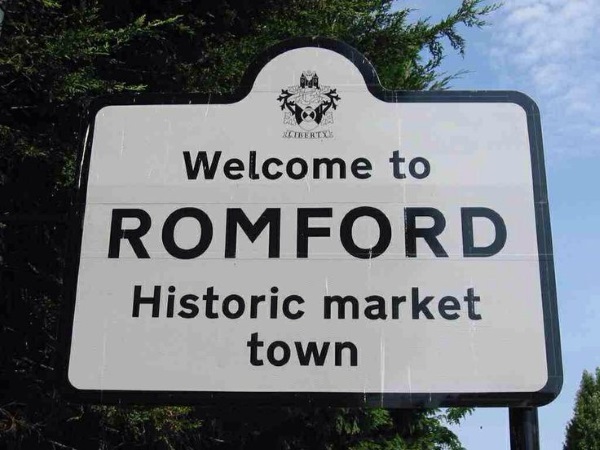
Romford
an Essex Market Town
The ancient Trinobantes tribe lived in
these parts, living off the land, using the marshes for protection and taking advantage of the forests which
covered south east England for shelter, food and fuel. When the Romans
came the Trinobantes joined the Iceni and, led by Boadicea, almost managed to drive the invaders from our
shores. To protect their military road, which ran from their capital
at Colchester to London, the Romans built an encampment in the Romford area. They called it Durolitum and to this day no one knows for sure where it
was.
When the Romans left, the Saxon kings
rapidly realised the importance of the area, with its forests alive with deer and wild boar and its marshland
teeming with game. Edward the Confessor particularly favoured Havering
and the rich sport it offered. The Normans arrived and organised the
land, royal favourites being given valuable tracts of land to administer and develop as feudal
estates.
In Plantagenet times Henry III granted a
charter in 1247 to the Sheriff of Essex to hold a livestock
market every
Wednesday. This assured the town's future
and has continued over the centuries to
develop into what we now know as the Romford market that exists today. In no time it became a centre for all kinds of trade and a place where
people of influence met. As the town grew, merchants and professional people came to live here, businesses
were set up, institutions established and a civic identity began to develop.

Edward IV recognised the growing stature
of the town in 1465 when he granted the Charter of the Liberty of Havering-atte-Bower with
Romford as its
capital. This gave the inhabitants of the Liberty, which
stretched from Havering in the north to the Thames in the south, a remarkable degree of
independence. Wrongdoers could only be tried before a court set
up by the people of the Liberty regardless of their alleged crime, the only exception being
treason. All conditions of trading, standards and quality of
goods and commercial agreements were determined by the Liberty's elected officers. The Liberty's independence from the County of Essex remained until it was
abolished on 9 May 1892.
The town of Romford has always had its economy governed by major transport
routes. Studies of a document dating from the 2nd century AD (called the Antonine Itinerary—a register
of the stations and distances along the various roads of the Roman empire), together with archaeological evidence,
reveal a Roman staging post called Durolitum somewhere in the vicinity of Romford. The Middle Ages saw the small hamlet that was in the area grow to a market
town. The leather industry started in Hornchurch found a ready market
in the number of travellers using the old Roman road to Colchester and Norwich.
Annoyed by the distance it was necessary
for them to travel to worship in Hornchurch, the people of Romford petitioned for a chapel nearer to the
town. The first chapel, dedicated to St Andrew, was built at the
east end of Oldchurch Road in 1177. Another petition was
submitted some years later and in 1405 a new chapel was erected in the Market Place, dedicated to St Edward
the Confessor. This became the new church, and the former chapel was known as the old church, a name
continued in that road and hospital today. The current St Edwards church was completed in 1850 and occupies
the same site as the earlier church.

With the arrival of the Eastern Counties Railway in 1839, Romford grew
rapidly. Although the line was originally designed to move freight, it
soon saw an increase in passenger trains. From 1850 Romford's growth
has been rapid.
The only buildings more than 100 years old are the Golden Lion on the
corner of High Street and North Street; the Church House in the Market Place, for some years the home of a chantry
priest and recently restored to church use after some years as an inn; and the mid-19th century Lamb public
house.
The names of some of Romford's residents are still well known; Francis
Quarles, the 17th century poet; Sir Anthony Cooke, the Tudor court official and royal tutor; and Colonel Blood, who
plotted to steal the crown jewels, once ran an apothecary's shop in Romford Market, and of course Benjamin &
Alice Rawlings.
Benjamin was a solicitor in Romford and London and was appointed by a
ratepayer poll to the position of vestry clerk for the parish of Romford in August 1842. He was also granted 'Freedom of the City of London'. This is one of the oldest surviving traditional ceremonies still in existence
today. It is believed that the first Freedom was presented in 1237.
The medieval term 'freeman' meant someone who was not the property of
a feudal lord, but enjoyed privileges such as the right to earn money and own land. Town dwellers who were protected by the charter of their town or city were often
free—hence the term 'freedom of the City'.
The English Census of 1841 records Benjamin and his family living at
Romford in the county of Essex. Ten years later the 1851 census places the number of Rawlings in Essex at 83. In
Middlesex they numbered 347, and in all of England the numbers ran to over two thousand, three hundred.
On 30th. of March, 1851, the night of the census,
Benjamin (38) and Alice (37) were living in Holborn, in the parish of St. Andrew, an inner suburb of London
close to the ‘Old Bailey’ courthouse, England’s central criminal court. The family numbered 11, including 5 children, 2 female visitors and 2 female
servants, Elizabeth Hitchcock and Elizabeth Lewis. Nine-year-old Francis, appears to have been staying with
the Palmer family close by in Islington. The other children were
Alice aged 12, Claude aged 7, Percival aged 5 and Constance aged 2. One of the visitors listed as a sister was 35-year-old Charlotte M.
Rawlings, the other being 51-year-old Frances Samuel from Swansea, Glamorgan in Wales, who may have been
Alice’s aunt. If the information recorded about Charlotte is
correct then when the 1841 census is checked, we find Charlotte (25) living with parents Samuel (66) and
Hannah (56) Rawlings at Oakham in the small county of Rutland, together with two other sisters Hannah (15)
and Eliza (7).
Constance, above, later married Llewellyn Thomas Sully and appears to have
died in the childbirth of their only child and daughter Lily, who received parcels at Southampton from my mother,
Ida Mary Chamberlain during the tough times of World War II. Although
apparently born in August 1850, Reginald’s name does not appear as part of the family on the 1851 Census, so
perhaps he was born 5 months later in August 1851.

(Far Side of the World-III)
|