Shirburn or Sherborne
From ‘A History of
Oxfordshire’
The following history is based largely on
copies of charters and other documents and maps
at Shirburn castle made by H. E. Salter, and
now in the Bodleian Library.
Shirburn, or
Sherborne like other Chiltern parishes, is narrow, being only ¾-mile across, and long, though its 3 miles is
nothing compared to the length of some others. We are informed in
the 1951 census that its area covers 2,421 acres and its boundaries. are probably much the same as they were in
Saxon times. Though adjustments may have been made over the
centuries knowledge of the ancient boundary was preserved by constant ‘processioning’.
processioning was a proceeding prescribed by statute for ascertaining
and fixing the boundaries of land.
The custom is referred to in a dispute
which occurred in 1636 between Edmund Symeon of Pyrton and John Chamberlain of Shirburn, apparently over the
customary right of parishioners of Shirburn to use a stile which was actually in Pyrton.
A small stream, flowing westwards to the
Thame, forms the short north-western boundary and divides the parish from Stoke Talmage; the county boundary
between Oxfordshire and Buckinghamshire bounds the parish at the southern end. The northern end of Shirburn lies mainly at about 300 feet; it rises gently to
375 feet in the centre and then steeply to 800 feet on Shirburn Hill, an outlying ridge of the
Chilterns. From here the land drops away again to 500 feet on the
south-eastern boundary. This hill character of the southern part of
the parish is reflected in the names of medieval fields, such Wethull, le Knappe, Wouslade (crooked
valley), and Bradeborweslade (broadbill valley).
The parish is notable for its fine beech
woods. In the Middle Ages it was more thickly wooded than now, but the woods were used for pasturing animals and
little care seems to have been taken to preserve the timber until the 17th century. Shirburn Park, surrounding the castle, is another outstanding feature of the
landscape and is largely the creation of the 18th century. A park
at Shirburn is first mentioned in 1336, when Alice de Lisle received permission to enclose 100 acres of wood and
40 acres of waste to make a park. Medieval parks, however, were not
grassland like modern ones, and the land enclosed is more likely to have been at the south-eastern end of the
parish than round the castle where the open fields lay.
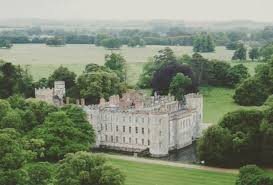
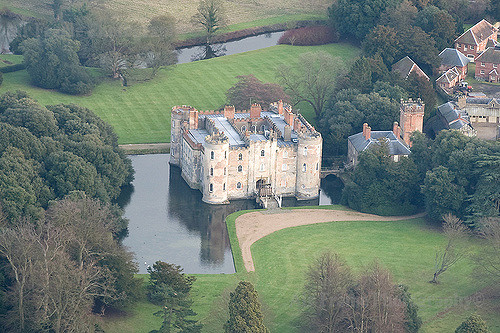
Shirburn Castle, Watlington, Oxford
The castle, as built in 1377, seems to
belong to a recognizable type of quadrangular castle, with four corner towers, that appears in the last quarter
of the 14th century. Shirburn castle probably consisted of a
quadrangle, enclosed by four ranges of buildings. With a round tower at each corner, and a gate tower in the
middle of the west side. The living quarters would have been
contained in the four ranges round the quadrangle; one might expect the hall to have been on the east side,
opposite the gate tower (as at Bodiam and Lumley). Of the original
building there survives the gate tower, the west outer wall, the south outer wall (now englobed
(contained) in later buildings), and probably the south-west and south-east towers; the other two towers
may have been rebuilt at the time of the extensive alterations in the 18th century. Originally there were three
drawbridges with a portcullis at the main entrance. The wide moat,
doubly wide on one side, is of running water supplied from springs on the east side of the castle and also in
the moat itself. In the 16th century Leland described the building
as a ‘strong pile or castlelet’. Sir Adrian Fortescue was often
there after he left Stonor, and an inventory of his goods at the castle made in February 1539, a few months
before his execution, throws some light on the internal arrangement of the rooms at this period. It mentions the wardrobe, the entry, the great chamber at the lower end of the
hall, the inner chamber, ‘the brusshynge howse’, the hall and the chamber over the parlour, and an inner chamber
there; there was also a cellar, buttery, chambers each for the butler, priest, horse-keeper, cook, and
chamberlains, an additional chamber, a low parlour, a kitchen larder, boulting house, fish-house, garner,
brew-house, and other outhouses.
From the end of the 15th century, when
Richard Chamberlain, his wife, and chaplain died there, to the middle of the 17th century the castle was lived
in, at least for a part of the year by the Chamberlains, who also had a London house, and they held it for the
king during the Civil War. The importance and size of the building
may be judged from the fact that in the 1660's it was among the eleven houses in the county for which 30 hearths
or more were returned for the hearth tax of 1665. Only the Earl of
Lindsey at Rycote, the Earl of Downe at Wroxton, the Earl of Clarendon at Cornbury, Sir Francis Lee at Ditchley,
Sir John Lenthall at Burford Priory, and William Knollys of Rotherfield Greys returned more than Shirburn’s 32
hearths. Michael Burghers depicts the castle on his map of the
county and the coat of arms of Lord Abergavenny, then lord of the manor, heads the 143 shields drawn in the
border.
When Thomas Parker, Earl of Macclesfield,
and soon to become Lord Chancellor, bought the castle in 1716 he made considerable alterations both to the
buildings and the park. A manuscript note made by him says that he
spent £7,000 on the house. As he bought a large library of books it
is likely that he was responsible for the two famous library-rooms and the main 18th-century
alterations. These included the rebuilding of the south and east
ranges, the construction of the fine staircase in the north-east comer, and the remodelling of the north and
west ranges. The present south range may represent the medieval south range, with new windows inserted and with
another range of rooms added to the south, outside the original outer wall. The west range, containing the gate tower and the old kitchen, was left
comparatively unaltered, except for new windows and the addition of a third story, thus raising this range to
the height of the others and dwarfing the gate tower. The north
range, when Brewer described it in 1819, contained the ‘capacious’ north library over the armoury and also on
the ground floor were marble baths, both warm and cold, and adds it is, ‘a luxury that too tardily creeps on the
notice of this country’. The armoury was the present entrance hall
which had probably been comparatively recently remodelled in the ‘Gothic’ taste and was shortly to be
illustrated in Skelton’s ‘Antiquities of Oxfordshire’.
In 1830 a fairly extensive modernization
was undertaken-a drawing-room and library over it were added on the north side; the old north library over the
hall was converted into a billiard room; the former drawing-room which had been over the dining-room on the east
side was converted into a larger bedroom and a dressing-room; and the baths on the ground floor on the north
side were removed. In 1870 the red-brick water tower adjoining the
laundry was built and in 1873 the warder's room in the north-west tower and the low entresol above it were
thrown into one to make a smoking-room.
The changes made during the 18th and 19th
centuries in the surrounding grounds were equally spectacular. A map of about 1718 shows the castle and moat
with a bowling-green and garden on the south-west side covering 5 acres. The church and home farm also lay to
the south-west, and to the north was the kitchen garden. The Great
and Little Closes, Forty Acres, and Mill Furlong, lying north and south of the castle were at this date arable
closes. William Burgess's map of 1736 presents quite a different
picture. The first earl made many exchanges of land, mainly with
the Tooveys, so as to be able to enlarge his pleasure grounds and divert the old public road. In 1720 he made the large ornamental water, called Upper Duckery, and by 1722
Homefield (30 a.) and Mill Furlong (50 a.) had been laid down to grass and avenues of Dutch elms planted in Mill
Furlong. The nursery was planted a few years later. The Long Pond
was made out of the one-time millpond: this marshy ground was purchased from Mr. Samuel Toovey on condition that
the new ‘pond’ should not injure in any way Toovey’s property. The
map of 1736 shows a formal garden to the north of the castle, and on the east a path running from the castle to
a circular lake and temple. Two designs for a garden temple bearing
the Macclesfield arms are in the Avery Library of Columbia University, U.S.A. They are attributed to the
architect, John Sanderson (d. 1783 ?). The existing circular temple appears, however, to have been designed by
Westby Gill of the Office of Work, for ‘Mr Gill’ is referred to as the architect in letters from the London
mason, Andrew Jelfe, relating to the supply of Portland stone for its construction in 1741.
In 1739 the astronomer with the help of
James Bradley built the observatory; twenty years later the first part of the walled garden was made, the home
farm was moved and in 1770 the churchyard was transferred from the north side of the church to the south
side.
Between 1780 and 1807 further improvements
were made. Davis’s map of 1790 shows the Dutch Elm Walk, the
Terrace Walk, and the Clare Walk to the north and north-west of the castle; there was a new flower garden and
Lower Duckery had been made. From a map of 1807 a new orchard laid
out to the north of the castle can be seen; the gardens to the south-west have been enlarged and now include a
melon ground, and the ponds to the west of the castle have also been enlarged. In these improvements a Mr. Ryston was the earl's adviser. By 1819 the park was said to cover roughly 60 acres, but was not admired by
Brewer in his guide who considered it ‘too flat to afford much interest’. Lord Torrington, writing earlier, in 1785, was even more critical of the park
and also of the house. He found the castle ‘melancholy and
tasteless’ in appearance and the place ‘very ugly’ and ‘in very ugly country’. But he was not in a position to give an unprejudiced view, for he had twice
been refused admission, the second time after a ‘tedious sultry ride of 16 miles’. Another contemporary view was that it was ‘sublime’ and left an ‘irresistible
impression on the soul of taste and sentiment’. A conservatory of
freestone and cast iron, and a pavilion for flowers were constructed early in the 19th century, perhaps in
anticipation of the royal visit in 1808 of queen Charlotte and her daughter princesses, The fine wall separating
the park from the Lewknor road is mainly built of chalk and brick and is largely late-18th-century or
early-19th- century work.
In British
historyinclosure or
enclosure, was the process of inclosing (with fences,
ditches, hedges, or other barriers) land formerly subject to common rights (commons). Such land included
fields cultivated by the open-field or strip system, wasteland, and the common pasture land. Inclosure
accompanied and accelerated the breakdown of the manorial system.
The enlargement of the park and the
enclosure of the open fields in 1806 led to great changes in the village. All the farmhouses below the hill once
lay in the village and were mostly west of the Lewknor road and to the east of the castle. In the mid-17th century there had been eleven farmhouses rated for the hearth
tax, of which four had three or four hearths. How many cottages
there were is uncertain, but rentals show that there must have been many families which escaped
taxation. Village society had its clear distinctions of rank: in
1622, for example, Elizabeth Adeane left 12d. to every cottager of the town and in 1642 Richard Adeane left 12d.
each to the four poor of Shirburn. The estate maps of 1736 and 1780
show the farms and cottages mainly round the church and castle to the west of the Lewknor road. The pound was opposite Scoles’s farm, which lay on the corner of the lane
leading to the church; the village cross was where the lane joined the Lewknor road. Several of the large farmhouses like Scoles’s, Butt’'s, and Reading’s had
large orchards. After enclosure the roads were fenced in and the
cross was removed. New farmhouses were built: the map of 1807 shows
Stone Hill Farm (later Model Farm) and Shirburn Farm to the north-west and north-east of the village, and
Knightsbridge Farm In the open fields to the south-west.
Judging from Brewer’s strictures the
cottagers were neglected. He noted that there were ‘many huts of
the most wretched description which act as offensive foils to the massive splendour of the neighbouring
castle’. The six derelict cottages now standing empty on the
Lewknor road are probably characteristic of the 18th-century village: they are timber-framed and have partly
brick and partly lath-and-plaster filling. The roofs are
thatched. Cottages and houses were restored or newly built in the
course of the late 18th and 19th centuries. There is a row of
fourteen pleasing cottages in Blenheim Road, a lane branching off the Lewknor road. They were designed as a row and are mostly of two stories, but four have
dormer windows; the material used is chalk with brick for decoration and for the chimney-stacks. Two of the present-day cottages were once a bakery, but one is now used as a
village shop. A group of houses facing towards the Lewknor road and
inside the entrance to the castle stables are also built of chalk and brick and appear to date from the late
18th or early 19th century. In the mid-19th century a school was
built. There has been no expansion in the 20th century: in 1960
there were reckoned to be 56 houses in the whole parish compared with 62 in 1811.
Although the position of the village at
the junction of the route along the foot of the Chilterns with the route which went at right angles through the
centre of Pyrton was strategically important, Shirburn seems to have played no important part in the conflicts
of the Middle Ages. The value of its position was no doubt
recognized by the Conqueror when he gave the village to two of his most trusted followers, Robert d’Oilly and
Roger d’Ivry, but there is no evidence that any Norman castle was built there.
In the 16th and 17th centuries the
Chamberlain ownership of the castle and manor made Shirburn a stronghold first of Puritanism, for Sir Leonard
was at one time an ardent Puritan and an active despoiler of churches, and then from the time of Tudor Mary I,
of Roman Catholicism, .Sir Leonard’s second son George rebelled against Queen Elizabeth I, fled abroad, and
married a Dutch lady. Thus It happened that Shirburn was visited on
the occasion of the funeral of Sir John Chamberlain in 1651 by their descendant, Dr. George Chamberlain, Bishop
of Ypres.
During the Civil War Shirburn was
garrisoned for the king and some of Sir John Chamberlain’s farm leases contain the provision that the tenant
must fight for the king if called on. In December 1644 Sir Francis
Harrington wrote that the enemy intended fortifying ‘a strong moated house belonging to Mr. Chamberlain’; and
that he intended surprising it as it was then only held by eight men and two pieces of ordnance: ‘it was 5 miles
from Thame and the like from Wallingford, and could’, he wrote, ‘much straighten the town, cut off all provision
from Thame …and shut up the passage to Abingdon’. Parliamentary
forces were in all the surrounding villages that year and 120 of their men taken by the royalists were
imprisoned in Shirburn castle. In August Sir Thomas Fairfax
arranged an exchange and Major Massie, who was with him at Shirburn, planted five pieces of battery on the
bowling-green, within a musket shot of the castle, and opened fire.
He was said also to be preparing to undermine it. In 1646
parliamentary troops besieging Oxford again threatened Shirburn, and Mrs. Chamberlain petitioned Parliament for
terms for the surrender of the castle. She claimed that the
garrison had never annoyed the parliamentary forces in the past twelve months, but on the contrary had
contributed provisions to the troops about Wallingford; that Mr. Chamberlain’s men-at-arms in the house had
prevented it from being an active garrison which would have much ‘annoyed’ Henley; that they only stood upon
their guard to defend themselves from plunder and never took any prisoners or raised contributions from the
country, The parliamentary comment on this was that ‘if true Shirburn had been different to any other part of
the country’. In June the ‘House’ was surrendered.
From 1716 until the present day the Parker
family has been resident At the castle and by 1900 the parish was entirely owned by it. Under the first two earls of Macclesfield Shirburn became a centre of
scientific and literary renown. The Lord Chancellor, ‘silver tongued’ Parker, was described by Bishop Warburton
as a ‘real Mæcænas’. He was the patron of authors and founded the fine library at the castle. Both he and his son were pupils and friends of William Jones, the
mathematician, who lived at the castle as one of the family. The
2nd earl, member for Wallingford 1722-7 and President of the Royal Society in 1752, took a keen interest in
astronomy and spent much time at Shirburn studying under Jones.
With the aid of James Bradley he built in 1739 an astronomical observatory, where he trained two assistants,
Thomas Phelps, the real discoverer of the Great Comet of 1743, and John Bartlett. One was originally a stable boy at Shirburn, the other a shepherd of Stoke
Talmage. Together with the earl they made many
observations. The earl, besides being responsible for introducing
the new style calendar, built a large chemical laboratory, added greatly to the library and patronized the arts.
His eldest son, Lord Parker, contested Oxfordshire in the New
Interest in the great election of 1754, an election which was notorious for the vast sums spent by both
sides. Lord Macclesfield gave a feast to 300 freeholders of
Watlington in 1752; establishing himself as the ‘darling of all this part of Oxfordshire’, and another in 1753.
Oxford dons dubbed Lord Parker ‘goody Bribery of Shirburn’, and another of the cries of the opposition’s
supporters was ‘give us back our eleven days’. Four out of
Shirburn’s six freeholders voted for Parker and Turner: these included two Tooveys-Richard of Watlington and
Samuel of Shirburn.
As 3rd Earl of Macclesfield Parker made
further additions to the library and by the time of his death in 1795 the six collections for which the library
is famous bad been brought together, and 12,700 or so printed books and 260 manuscripts had been
assembled. The additions since his time have been
negligible. It consisted of (1.) the valuable collections of
scientific works and letters collected by William Jones and bequeathed to the 2nd earl; (2.) about 450 Bibles;
(3.) the Welsh collection of the Welsh antiquary, the Revd. Moses Williams, which was left to William Jones;
(4.) a large collection of books on linguistics; and (5.) two important collections bequeathed to the 3rd
earl. The first of the last two collections came from the Master of
the Rolls in 1754, the second consisting of military works came from the Hon. George Lane Parker, the earl’s
brother. The library contains many first editions of early English books, including two Caxtons, and among its
most valuable manuscript possessions is the unique Liber de Hida and many letters of Sir Isaac
Newton.
Amongst the portraits at Shirburn
commissioned by the first three earls are one of Thomas, the 1st earl by Kneller; George, the 2nd earl by
Hogarth and of his first wife by Kneller; of William Jones by Hogarth; and of Thomas the 3rd earl and his wife
by Ramsay. This tradition of patronage of leading artists was followed by George, the 4th earl, who commissioned
Ramsay to paint his wife Mary Frances.
MANORS. In 1086 Shirburn was divided
between two lords, two of the greatest tenants in Oxfordshire, Robert d’Oilly and Roger d’Ivry, who were sworn
companions in arms and had arranged to divide their spoils. The
latter held in chief a manor assessed at 10 hides and later sometimes called ‘East
Shirburn’. From the D’lvry barony the overlordship passed to
the honour of St. Valery which was eventually attached to the Earldom of Cornwall. The mesne tenant in 1086 was one Ralph.
In the feudal system a
mesne tenant was a vassal who held his land from a mesne lord who was himself the vassal of a
higher lord.
A vassal was one
who paid feudal homage to a superior lord, and who promised military service and advice and labour in return
for a grant of land.
Under the feudal system,
enfeoffment was the deed by which a person was given land in exchange for a pledge of
service.
He may have been the father of Roger, who
was the son-in-law of Drew d’Aundeley, tenant of the second Shirburn manor. Nothing further is known of him nor of the enfeoffment by which this estate
was later held for 2 fees. In about 1234-7 the overlord Richard,
Earl of Cornwall, granted it to Henry le Tyeys in exchange for Grendon Underwood (Bucks.), to be held for the
same service as Grendon. This was presumably the agreement under
which Shirburn’s 2 fees and the manor were held like Grendon for the yearly render at North Oseney court of an
ebony bow without string and 3 barbed arrows without feathers or 12d. The Le Tyeys family, whose chief seat was eventually Chilton Foliot (Wilts.),
held Shirburn during the 13th century. The Sir Henry le Tyeys (or
Teutonicus) who held it in 1279, and was lord of Fritwell and Albury as well as of estates in several
other counties, was presumably the son of the earlier tenant. He
had died by 1282, leaving an heir, of the same name, who was still a minor in 1284. Sir Henry (III) le Tyeys, later Lord Tyeys, died in 1307. His son Sir Henry, 2nd Lord Tyeys, was Keeper of Oxford city in 1311 and
became one of the leaders of the revolt against the Despensers and a strong supporter of Thomas of
Lancaster. His estates were forfeited and in 1322 he himself was
hanged. His heir was his sister Alice, widow of another rebel
leader, Warin de Lisle, but she was not granted her brother’s property until 1327. Her younger son Henry, who took the surname Le Tyeys, was perhaps grunted
Shirburn before his mother's death 1347; he certainly held it at his own death in 1361, by which time he had
acquired the ‘manor of Burgfield’, a half of the D’Oilly manor. His
heir was his nephew Warin, Lord Lisle, son of his brother Gerard.
Warin (d. 1382) left his estates to his only daughter Margaret, Baroness Lisle, wife of Thomas, Lord Berkeley,
but Warin’s widow Joan had a life interest in Shirburn manor (i.e. the D’Ivry half) and in the ‘manor of
Burgfield’ until her death in 1392. Berkeley died in 1417, his heir
being his daughter Elizabeth, wife of the powerful Richard Beauchamp, Earl of Warwick, guardian and tutor of
Henry VI. On her death in 1422 her estates were divided between her
three daughters and co heiresses, Margaret, Countess of Shrewsbury, Eleanor, Lady Ros, and Elizabeth, Lady
Latimer. In 1427 and 1435, however, Richard Quatremain of North
Weston bought their Shirburn property (i.e. three parts of the manor), and in 1432 he acquired from the
Collingridges the fourth part of Shirburn manor and thus united the whole lordship under himself. Shirburn was not mentioned in Quatremain’s will and had probably been granted
already to his kinsman and friend Richard Fowler, Chancellor of the Duchy of Lancaster (d. 1477), although it is
not mentioned in his inquisition post mortem.
The chancellor’s son Richard Fowler, who
was a ‘very unthrift’ and became a pensioner of his mother Jane Fowler in 1501, gave Shirburn as security for a
loan. Sybil Chamberlain, the widow of Sir Richard Chamberlain of
Woodstock and the daughter of chief executrix of Jane Fowler, who died in 1505, took possession of Shirburn
manor in April 1505 as the debt was unpaid. In May Richard Fowler.
by now knighted, leased the manor to his sister and her son Sir Edward Chamberlain for 60 years and in 1527 Sir
Edward obtained full rights over Shirburn by giving his uncle Tilsworth and Stanbridge manors (Beds.) in
exchange. On Sir Edward’s death in 1542, he was succeeded by his
eldest son Leonard who added to the Shirburn property by buying land from Ambrose Dormer and the rectory and
advowson from the Crown.
advowson
is the right in English law of presenting a
nominee to a vacant ecclesiastical benefice. In effect this means the right to nominate a person to hold a
church office in a parish.
Sir Leonard who, like his father, had been
Sheriff of Oxfordshire and Berkshire, died in 1561 leaving a life interest in the manor to his second wife
Agnes. As his son Francis Chamberlain predeceased Agnes in 1570, it
was Francis’s eldest son Robert (d. 1600) who succeeded. Robert’s
heir Sir Robert Chamberlain was in a ship which vanished in the Levant in 1615 and the manor fell into the hands
of the Crown for six or seven years until the death of Sir Robert became certain. The Chamberlains were a Roman Catholic family and Sir Robert’s next heir was
his cousin George Chamberlain, Bishop of Ypres, who renounced his claim in favour of John Chamberlain the son of
his brother Sir John Chamberlain. This John Chamberlain leaving two
co heiresses: Elizabeth, wife of John Neville Lord Abergavenny, and Mary, wife of Sir Thomas Gage, Bt., of Firle
(Suss.) and later of Sir Henry Goring, Bt. There was a complicated
division of his Shirburn estates by which the Abergavenny family had the manorial rights, the castle, and most
of the rents and the Gages had the demesne subject to certain limitations. The woods and the rectory were divided equally. The manorial courts were held for a group of trustees, called the lords of the
manor, until 1659, but for Lord Abergavenny (d. 1662) in 1661 and in 1668 for his widow Elizabeth, Baroness
Dowager of Abergavenny. The date of Elizabeth’s death is uncertain,
but it was before 1682 when her nephew Joseph Gage, the younger son of Lady Mary Goring, was in
possession. Joseph’s son Thomas Gage sold Shirburn and Clare manor
in 1716 for £25,696-8s-5d. to Thomas, Baron Parker (d. 1732), the eminent lawyer and Lord Chief
Justice, later Lord Chancellor and 1st Earl of Macclesfield of the second creation. The manor has remained in the possession of the earls of Macclesfield until
the present day.

|